How to Help Kids Follow Routines With Fewer Reminders
By KindSteps / Hule Technology · Originally published 2026-09-15 on X
Make routines visible, pause before helping, and use small prompts to support children's everyday independence.

Independence rarely arrives as one dramatic milestone.
It grows in ordinary moments: a child searching for a missing shoe, opening the toothpaste, remembering what belongs in a school bag, or trying to fasten a jacket before asking for help.
These moments are small, but they contain a choice for the adult nearby. Do we step in immediately, give another reminder, or wait long enough for the child to take the next step?
That pause can feel surprisingly difficult.
The pause can feel like doing nothing
Parents help because they care. We also help because mornings are busy, spilled milk is inconvenient, and watching a child struggle can be uncomfortable.
Stepping in often solves the immediate problem. The shoes get tied. The bag gets packed. Everyone gets out the door.
But speed and learning are not always the same goal.
When an adult completes a task at the first sign of hesitation, the child loses a repetition. No single lost repetition matters very much. Across hundreds of ordinary moments, though, the pattern can become important: the adult notices, reminds, and rescues; the child learns to wait.
The alternative is not to withdraw support. It is to change the timing of support.
Independence grows when help remains available without arriving too early.
Scaffolding is not abandonment
“Let them do it themselves” can sound harsh if it means leaving a child alone with a task that is too difficult.
Useful independence practice sits between two extremes. On one side is rescue: the adult takes over. On the other is abandonment: the child is expected to manage without enough skill or structure.
Scaffolding occupies the middle.
It might look like:
- Making the next step visible
- Offering two choices instead of an open-ended command
- Demonstrating once, then letting the child try
- Asking, “What comes next?” before giving the answer
- Helping with only the hardest part
The adult is still present. The task simply remains in the child’s hands.
Make the next step easier to see
Many instructions that sound simple to adults contain several hidden decisions.
“Get ready” may mean wash your face, get dressed, eat breakfast, brush your teeth, find your shoes, and pack your bag. A child who stalls may not be refusing the routine. They may not know where to begin—or may be holding too many steps in working memory at once.
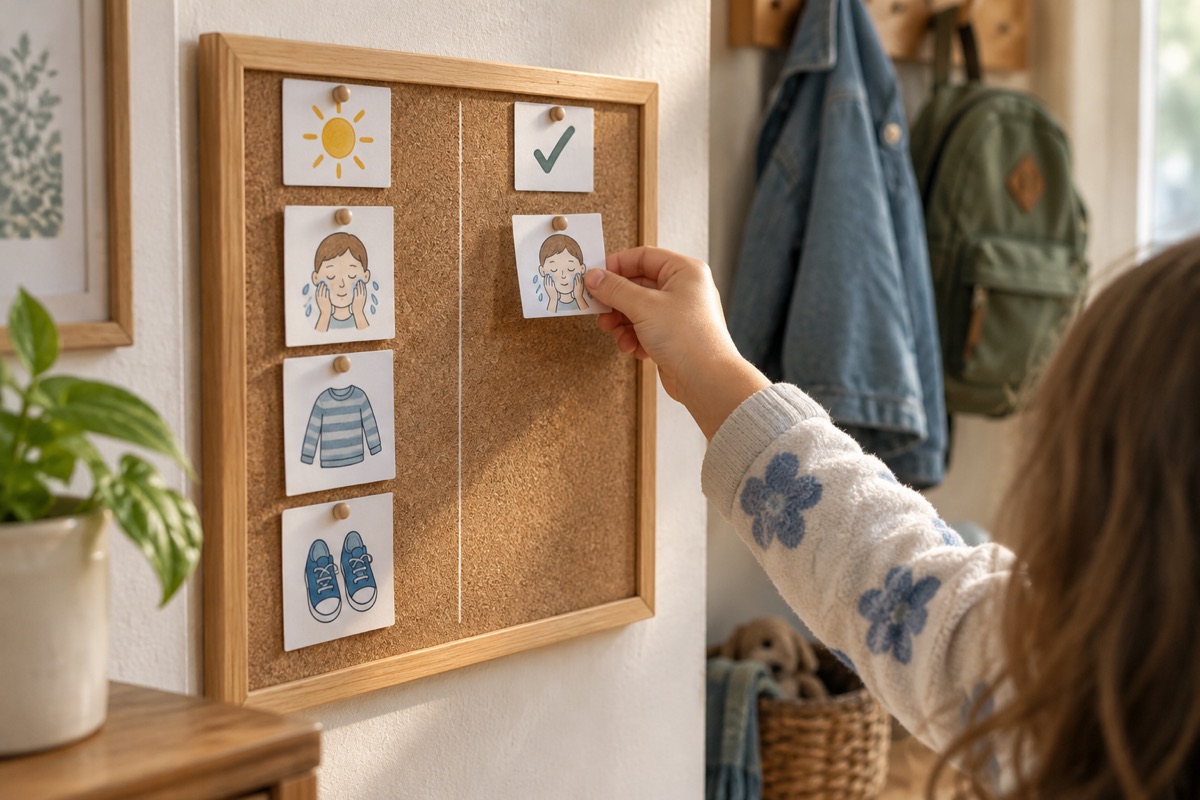
A visible sequence reduces that invisible load. Pictures, objects placed in order, or a short three-step list can answer the question “What now?” without another adult reminder.
The goal is not to control every movement. It is to make the path clear enough that the child can move along it.
Use the smallest helpful prompt
When a child gets stuck, adults often add more language. We repeat the instruction, explain why it matters, mention the time, and describe what will happen if the family is late.
More words can create more pressure without creating more clarity.
Try moving through a simple ladder of support:
- First, pause.
- Then point to the visible next step.
- Ask one short question: “What comes next?”
- Offer a choice: “Shirt or pants first?”
- Help with one difficult part, then return the task.
Stop as soon as the child can continue. The smallest successful prompt leaves the most room for ownership.
Measure growth by fewer reminders
A perfectly smooth morning is not the only evidence of progress.
Look for smaller changes:
- The child starts one step without being asked.
- A long reminder becomes a short question.
- The child notices a mistake and returns to fix it.
- A task that required full help now needs help only at the end.
- The routine recovers after distraction.
These are meaningful signs of learning. Independence is not the absence of mistakes; it is the growing ability to continue after them.
Connection and independence belong together
Children do not need adults to become distant. They need adults who can stay connected without taking over.
A calm presence communicates: “I am here if you truly need me, and I believe you can attempt this.” That message is different from both pressure and praise. It expresses trust.
Over time, the child begins to borrow that trust. “My parent thinks I can try” slowly becomes “I know how to begin.”
This is why the pause before helping matters. It is not empty time. It is practice space.
The next time your child hesitates during an ordinary routine, try waiting ten seconds before stepping in. Watch what they look at, what they attempt, and where they actually need support.
What is one everyday task your child might be ready to own if you waited just a little longer?
Originally shared as an X Article. This website edition uses a descriptive title and accessible web formatting.
Practical routine ideas from the KindSteps team. Examples are illustrative; every child may need a different level of support.
Download KindSteps for Android